
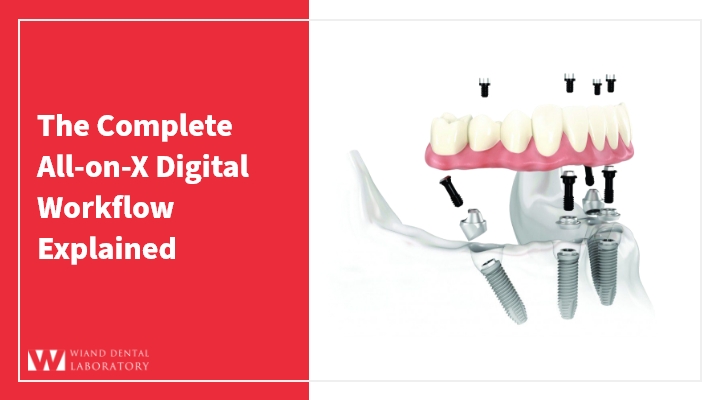
The Complete All-on-X Digital Workflow Explained
The All-on-X procedure has transformed full arch rehabilitation. But the real transformation is happening behind the scenes — in the digital workflow that supports it.
A complete All-on-X digital workflow connects surgery, prosthetics, and lab fabrication into a seamless system. When executed properly, it increases precision, reduces complications, and improves long-term outcomes.
Step 1: Digital Data Capture
Everything begins with accurate data.
Depending on the case, this may involve:
- CBCT imaging
- Intraoral scanning
- Photogrammetry or Grammetry
- Bite registration
- Digital smile design
Accurate implant-level data ensures the prosthesis fits passively and functions correctly.
Step 2: Surgical Planning Integration
Digital workflows allow surgical planning software to integrate directly with restorative design. Implant positions are not placed arbitrarily — they are prosthetically driven.
This improves:
- Implant angulation
- Prosthetic screw access
- Emergence profile
- Final esthetics
Restorative and surgical teams collaborate before the first incision is made.
Step 3: Digital Conversion or Provisional Design
After implant placement, digital conversion techniques allow precise fabrication of a provisional prosthesis.
Using CAD software, the lab designs a temporary restoration that:
- Maintains vertical dimension
- Protects implants during healing
- Provides immediate esthetics
- Establishes proper occlusion
The provisional becomes the blueprint for the final prosthesis.
Step 4: Final Prosthetic Design
After healing, updated scans are captured. The final prosthesis — often zirconia or hybrid — is digitally designed based on validated provisional data.
Advantages include:
- Reduced remakes
- Improved passive fit
- Precise occlusion
- Digital archiving for future remakes
The lab can fine-tune esthetics and function digitally before manufacturing.
Step 5: Delivery and Long-Term Maintenance
Because every step is digitally documented, maintenance and future adjustments are simplified.
If a prosthesis fractures or requires replacement, digital records allow rapid reproduction.
Why the Digital Workflow Matters
A fully digital All-on-X workflow offers:
- Predictable implant-level accuracy
- Reduced chair time
- Better communication
- Fewer mechanical complications
- Improved patient satisfaction
Analog shortcuts introduce variability. Digital workflows reduce variability.
Competitive Advantage for Practices
Practices that adopt a complete digital workflow gain:
- Marketing differentiation
- Faster case turnaround
- Stronger lab collaboration
- Higher patient confidence
Digital All-on-X workflows are not just clinical improvements — they are business improvements.
Transform Your Full Arch Cases with a Digital Partner
Wiand Dental Lab specializes in complete All-on-X digital workflows — from conversion to final zirconia. If you’re ready to reduce complications, streamline your surgical days, and deliver more predictable outcomes, partner with a lab that understands full arch at the highest level.
Contact Wiand Dental Lab today to discuss your next All-on-X case.