
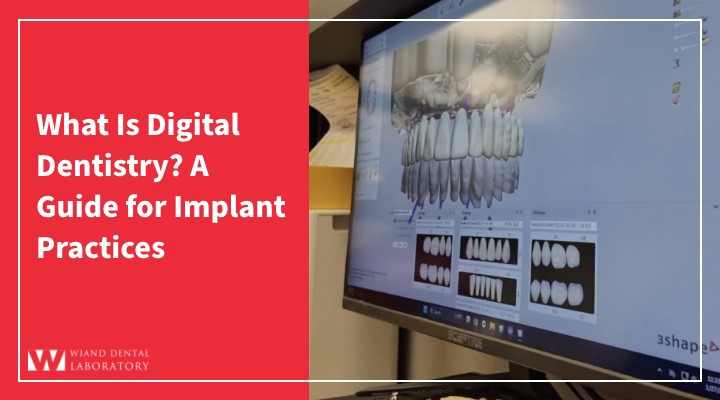
What Is Digital Dentistry? A Guide for Implant Practices
Digital dentistry is the integration of advanced digital technologies into diagnosis, treatment planning, surgical execution, and restorative fabrication. In implant-focused general practices, digital dentistry is not simply about owning an intraoral scanner or milling unit. It is a structured, data-driven workflow designed to reduce variability, improve biomechanical precision, and increase long-term predictability.
For GP implant providers expanding into single implants, All-on-X, and full arch rehabilitation, digital dentistry represents a fundamental shift from analog approximation to engineered control.
At its core, digital dentistry reduces distortion.
The Limitations of Traditional Analog Workflows
Traditional restorative workflows rely heavily on physical transfer processes:
- Elastomeric impression materials
- Transfer copings
- Stone model fabrication
- Manual articulation
- Physical shipping
- Analog framework fabrication
Each of these stages introduces potential dimensional change. Impression materials shrink. Stone models expand. Analogs may not seat perfectly. Articulation may vary slightly between operators.
In single-unit dentistry, small discrepancies may be corrected chairside. In multi-implant restorations, those discrepancies accumulate. Cumulative error leads to framework tension, occlusal imbalance, and long-term mechanical complications.
Digital dentistry reduces these embedded distortion points.
Core Components of Digital Dentistry in Implant Practices
Digital dentistry in implant-focused GP practices typically includes five integrated pillars.
1. CBCT Imaging and Prosthetically Driven Planning
Cone Beam Computed Tomography (CBCT) allows three-dimensional evaluation of bone volume, anatomical structures, and implant positioning.
Rather than placing implants based solely on bone availability, prosthetically driven planning aligns implant position with restorative design.
Digital planning improves:
- Implant angulation
- Avoidance of anatomical structures
- Restorative space management
- Multi-unit abutment alignment
- Screw channel trajectory control
Surgical predictability begins before the incision.
2. Intraoral Scanning
Intraoral scanners replace traditional impression materials by capturing digital impressions of dentition, soft tissue, and restorative space.
Benefits include:
- Elimination of impression distortion
- Immediate verification of scan accuracy
- Enhanced patient comfort
- Faster laboratory communication
For implant restorations, scanner integration reduces analog transfer error and accelerates workflow.
3. Optical Implant Capture (Grammetry / Photogrammetry)
In multi-unit implant cases, implant-level accuracy is critical. Optical implant capture systems record three-dimensional implant positions without physical impression materials.
This eliminates:
- Transfer coping rotation
- Impression shrinkage
- Stone model expansion
- Analog placement inaccuracies
By preserving true implant orientation, passive fit can be engineered more reliably.
4. CAD-Based Restoration Design
Computer-Aided Design (CAD) software allows restorations to be engineered digitally before fabrication.
Technicians can:
- Evaluate implant angulation
- Control framework thickness
- Design reinforcement zones
- Balance occlusion
- Validate vertical dimension
- Manage cantilever length
Instead of relying on post-fabrication adjustment, restorative parameters are built intentionally.
Engineering replaces approximation.
5. CAD/CAM Fabrication
Digitally designed restorations are milled or printed using high-strength materials such as zirconia or reinforced PMMA.
Digital fabrication improves:
- Dimensional consistency
- Material strength
- Reproducibility
- Surface precision
Because the restoration is fabricated directly from verified digital data, cumulative distortion is reduced.
Digital Dentistry in Full Arch Implant Cases
Full arch implant dentistry is where digital integration provides the greatest advantage.
When four to six implants are splinted together:
- Passive fit becomes critical
- Occlusal balance must be controlled
- Cantilever forces must be managed
- Framework strain must be minimized
Digital workflows reduce embedded strain by eliminating analog distortion and engineering framework geometry intentionally.
Implant positions are captured optically. Frameworks are designed digitally. Occlusion is validated before milling. Delivery becomes confirmation rather than correction.
Reduced strain leads to:
- Lower screw loosening incidence
- Fewer prosthetic fractures
- Improved implant longevity
- Reduced maintenance visits
Digital control strengthens long-term stability.
Immediate-Load Protocols and Digital Control
Immediate-load All-on-X treatment requires precise load management during osseointegration.
Digital workflows allow occlusion to be engineered before provisional fabrication. Balanced centric contacts and controlled cantilever zones reduce micromovement during healing.
By managing load proactively, implant stability improves.
For GP implant practices incorporating immediate loading, digital integration increases confidence.
Workflow Efficiency and Structured Communication
Digital dentistry improves communication between practice and laboratory.
Secure digital case submission includes:
- Implant system documentation
- Abutment specifications
- Restorative space notes
- Surgical timing coordination
- Design preferences
Structured communication reduces remake risk and improves turnaround time.
Efficiency improves without sacrificing precision.
Digital Archiving and Long-Term Serviceability
One often overlooked advantage of digital dentistry is long-term reproducibility.
When restorations are designed digitally, CAD files can be archived indefinitely.
If a prosthesis fractures years later, reproduction can occur from stored digital data rather than repeating impressions.
This improves:
- Patient convenience
- Practice efficiency
- Remake accuracy
- Long-term scalability
Digital continuity supports program growth.
Why Digital Dentistry Is Becoming the Standard
As implant dentistry evolves, digital integration is becoming the structural standard for predictable outcomes.
GP implant practices benefit from:
- Reduced cumulative distortion
- Improved passive fit
- Controlled occlusion
- Lower complication rates
- Increased consultation confidence
- Competitive differentiation
Digital dentistry is not a trend. It is a shift toward engineered precision.
Strengthen Your Implant Program Through Digital Integration
Digital dentistry provides the structural foundation for predictable implant outcomes. When CBCT planning, optical implant capture, CAD engineering, and precision fabrication operate as a cohesive system, complication risk decreases and delivery confidence increases.
Wiand Dental Lab partners with GP implant practices to deliver fully integrated digital workflows engineered for passive fit, balanced occlusion, and long-term durability.
Contact Wiand Dental Lab today to strengthen your implant program with precision-driven digital dentistry solutions built for predictability, efficiency, and sustainable growth.