
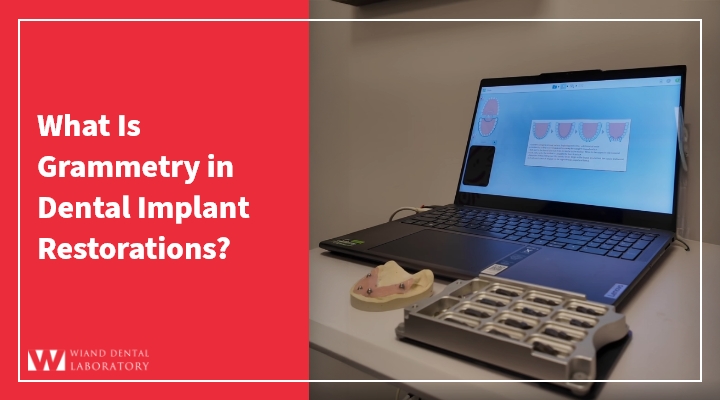
What Is Grammetry in Dental Implant Restorations?
Precision is everything in full arch implant dentistry. When multiple implants must function together under load, even minor inaccuracies in position capture can lead to mechanical complications, prosthetic stress, or long-term failure.
This is where Grammetry in dental implant restorations becomes critically important.
As full arch and All-on-X cases increasingly move toward fully digital workflows, Grammetry technology is helping practices and dental labs achieve implant-level accuracy that traditional impression techniques simply cannot match.
What Is Grammetry?
Grammetry refers to advanced optical implant position capture technology used in digital dentistry. It is often associated with high-precision photogrammetry systems that record the exact three-dimensional spatial location of implants in the mouth.
Rather than relying on impression material, analog transfers, or verification jigs, Grammetry systems use calibrated optical scanning to:
- Capture implant positions with micron-level accuracy
- Record angulation and spatial relationships
- Eliminate distortion caused by impression materials
- Provide true implant-level data for CAD design
In simple terms, Grammetry replaces mechanical approximation with digital precision.
Why Implant Position Accuracy Matters in Full Arch Cases
In single-tooth restorations, small discrepancies can sometimes be adjusted chairside. In full arch restorations, those discrepancies multiply.
When four, five, or six implants must function together, even a slight misalignment can create:
- Framework strain
- Screw loosening
- Prosthetic fractures
- Occlusal instability
- Long-term implant stress
Passive fit is not optional in All-on-X and full arch implant cases — it is essential.
Grammetry improves the likelihood of achieving a truly passive fit by eliminating many of the variables associated with traditional impression workflows.
Grammetry vs. Traditional Open-Tray Impressions
For decades, open-tray impressions have been the standard for implant-level data capture. While effective, they rely on multiple steps:
- Impression coping placement
- Splinting
- Impression material application
- Stone model pouring
- Analog placement
- Model scanning
Each step introduces potential error.
Impression materials can distort. Stone models can expand. Copings can shift. Even slight inaccuracies can compound in multi-unit cases.
Grammetry removes most of these variables by capturing implant position digitally and directly.
Advantages of Grammetry Over Traditional Techniques
- No impression material distortion
- No model expansion or shrinkage
- Reduced need for verification jigs
- Faster data acquisition
- Immediate digital transfer to the lab
- Greater confidence in passive fit
For high-volume implant practices, this efficiency significantly improves workflow predictability.
How Grammetry Integrates into a Digital All-on-X Workflow
Grammetry is most powerful when used as part of a complete digital workflow.
A typical sequence may include:
- CBCT imaging for surgical planning
- Guided implant placement
- Grammetry capture of implant positions
- Digital bite and soft tissue scanning
- CAD design of provisional or final restoration
- Milled or printed prosthesis fabrication
Because the implant data is digitally captured with high precision, the lab can design frameworks that align accurately with implant platforms and angulations.
This reduces the need for adjustments at delivery and lowers the risk of mechanical complications.
The Impact on Immediate Load Cases
Immediate load All-on-X cases place even greater importance on prosthetic accuracy. The provisional restoration often plays a stabilizing role during osseointegration.
If the provisional introduces strain, implant micromovement may occur.
By using Grammetry to capture exact implant positions, clinicians can deliver provisionals that:
- Seat passively
- Minimize stress on implants
- Maintain proper occlusion
- Support predictable healing
This level of precision improves surgical-day confidence and long-term outcomes.
Benefits for Surgeons and Prosthodontists
Practices adopting Grammetry technology report several key advantages:
1. Reduced Chairside Adjustments
Frameworks are more likely to seat passively without extensive modification.
2. Fewer Remakes
Accurate data reduces the likelihood of prosthetic misfit.
3. Improved Surgical Efficiency
Data capture is faster than traditional impression methods.
4. Enhanced Collaboration with the Lab
Digital files are transferred instantly, allowing quicker design initiation.
5. Stronger Patient Confidence
Patients perceive advanced digital workflows as modern and precise.
For prosthodontists handling complex rehabilitations, Grammetry provides greater control over restorative outcomes.
Why Lab Expertise Still Matters
While Grammetry captures precise implant data, the quality of the final restoration still depends heavily on lab execution.
A dental lab must understand:
- Multi-unit abutment protocols
- Tissue management considerations
- Occlusal schemes in full arch cases
- Material selection (zirconia, hybrid, PMMA)
- Framework biomechanics
Accurate data is powerful — but only when paired with experienced full arch design.
The lab’s ability to interpret and design from Grammetry data determines whether the final prosthesis achieves true passive fit and long-term stability.
Is Grammetry the Future of Implant Data Capture?
As digital dentistry continues to evolve, Grammetry is quickly becoming a preferred method for implant-level data capture in complex cases.
Full arch implant dentistry demands precision. Practices that invest in high-accuracy digital systems are positioning themselves for:
- More predictable outcomes
- Greater efficiency
- Fewer mechanical complications
- Stronger restorative-lab collaboration
Grammetry represents a shift from approximation to engineered precision.
Elevate Your Full Arch Cases with Precision
Capturing implant data accurately is only half the equation. Designing and fabricating full arch restorations from that data requires deep expertise in All-on-X biomechanics and digital workflow integration. Wiand Dental Lab integrates advanced Grammetry workflows into digital conversions and full arch implant restorations to ensure implant-level precision from scan to final prosthesis. If your practice uses Grammetry — or is considering implementing it — partner with a lab that understands how to turn precise digital data into predictable, passive-fitting restorations.
Contact Wiand Dental Lab today to discuss your next full arch case and experience the confidence that true digital precision provides.