
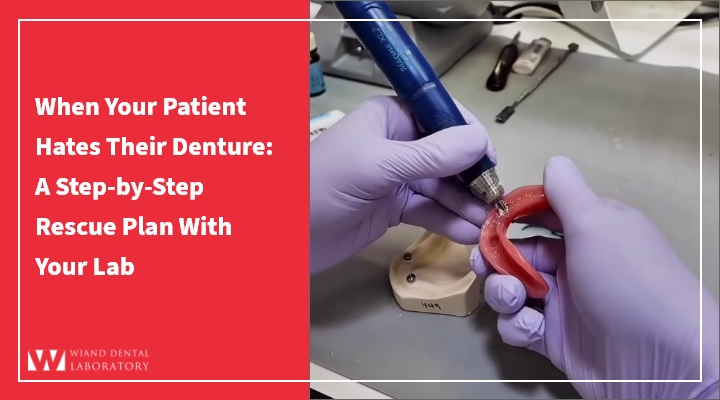
When Your Patient Hates Their Denture: A Step-by-Step Rescue Plan With Your Lab
Every dentist has met this patient: the one who sits down, looks frustrated, and says, “I hate these dentures.”
Maybe they can’t chew. Maybe they can’t talk without whistling or lisping. Maybe they hate how they look in photos. Whatever the reason, you’re suddenly managing not just a prosthesis problem, but a trust and confidence problem too.
The good news: you don’t have to solve it alone. When you work closely with your lab, a “disaster denture” can become a powerful save that actually deepens the patient’s trust in you.
Here’s a practical, step-by-step rescue plan you can follow with your lab partner.
Step 1: Listen First and Define the Complaint
Before you touch anything, give the patient time to talk.
Common complaints tend to fall into a few buckets:
-
Fit/comfort: “They hurt,” “They feel loose,” “I can’t keep them in.”
-
Function: “I can’t chew,” “Food gets underneath,” “They pop up when I talk.”
-
Esthetics: “I don’t like the way they look,” “They’re too big/too long/too white.”
-
Phonetics: “I can’t say my S’s or F’s,” “I sound funny on the phone.”
Write their concerns down in their own words. This becomes your roadmap—and it’s exactly the type of information your lab needs to understand the problem.
Step 2: Check the Basics – Fit and Occlusion
Next, confirm what’s really happening clinically.
Things to evaluate:
-
Tissue adaptation and pressure spots
Use pressure-indicating paste to locate overextensions or pressure areas. -
Stability and retention
Evaluate border seal and movement under functional load. -
Vertical dimension of occlusion (VDO)
Is the patient over-closed or over-open? Look at facial thirds, rest position, and phonetics. -
Centric relation vs. centric occlusion
Are you actually hitting the recorded jaw relationship?
If you find that fit or occlusion is off, your lab can help you decide whether the case is best handled with:
-
Adjustments and a reline
-
A new bite registration and remount
-
A full remake with corrected records
-
Consideration of implant support for better stability
The key is to share your clinical findings with the lab, not just “the patient doesn’t like it.”
Step 3: Evaluate Esthetics With the Patient, Not Just For Them
Esthetics are personal, and patients often struggle to articulate why they don’t like their denture. Guide the conversation by breaking it down into simple pieces:
-
Tooth size and shape: Too big? Too small? Too square/too round?
-
Tooth shade: Too white? Too dark? Not matching their age or skin tone?
-
Tooth arrangement: Too straight? Too perfect? Do they want a little individuality?
-
Lip support and smile line: Do they feel “pushed out,” collapsed, or gummy?
Take photos—full-face at rest and in smile, side views, and close-ups. These images are incredibly valuable for your lab. At Wiand Dental Lab, for example, photos often make the difference between guessing and nailing the next setup.
If the patient has an old denture they liked better, send that in as well. It can be a powerful reference for tooth position, size, and overall look.
Step 4: Assess Phonetics Systematically
Phonetics complaints can be some of the most emotional: patients are embarrassed to speak, answer the phone, or meet people. A structured approach helps.
Have the patient say:
-
“Sissy sells seashells” (S sounds)
-
“Fifty-five” (F and V sounds)
-
“Emma,” “Mommy,” “Mississippi” (M and general speech)
Watch:
-
Tooth length and position: Are the maxillary anterior teeth too long, too short, too far labial?
-
Palatal thickness: Is the palate too bulky and affecting tongue space?
-
VDO: Is the vertical dimension contributing to speech distortion?
Share your observations with your lab. Small changes in tooth positioning, palatal contour, and VDO can dramatically improve speech when coordinated properly.
Step 5: Re-Record and Refine Your Records
If you confirm that the issue isn’t just a small adjustment, it’s worth going back to fundamentals:
-
New impressions with proper border molding
-
New jaw relation records with attention to VDO and centric relation
-
Facebow (if you use one) and detailed occlusal scheme preferences
-
A new esthetic prescription based on patient feedback and photos
This is where your lab can be your greatest asset. A collaborative lab will:
-
Review your records and point out any gaps
-
Suggest additional records (photos, videos, bite registrations) if needed
-
Help you choose the best workflow—traditional, digital, or a combination—for the remake or major revision
Step 6: Use the Try-In as a True Test Drive
For a rescue case, the try-in appointment is critical. Slow down and involve the patient:
-
Check esthetics from all angles—have them look in a hand mirror and photos.
-
Test speech with your go-to phrases.
-
Confirm VDO, comfort, and lip support.
-
Ask them, “Is there anything at all you would change right now?”
Document any requested changes and send photos and notes back with the try-in. Your lab can then fine-tune tooth position, contour, and occlusion before processing the final prosthesis.
At Wiand Dental Lab, these collaborative try-ins are where many “I hate my denture” cases transform into “I love my new smile.”
Step 7: Reset Expectations and Present a Plan
Patients feel better when they know there’s a clear, structured plan. Summarize:
-
What went wrong (in simple terms)
-
What you and your lab will do differently this time
-
How many visits to expect
-
What you need from them (honest feedback, patience during adaptation, good home care)
When you present this as a shared effort between you and a dedicated lab partner, it reassures the patient that they’re getting a more thoughtful, customized solution—not just another “set of teeth.”
Partner With a Lab That Helps You Rescue Tough Cases
Denture rescue cases can be stressful, but they’re also a chance to show patients how committed you are to getting things right.
At Wiand Dental Lab, we work side-by-side with dentists on:
-
Troubleshooting unhappy denture and full-arch cases
-
Reviewing records, photos, and prior prostheses
-
Recommending design changes that improve fit, esthetics, and phonetics
-
Providing diagnostic setups and clear communication at every step
If you’re facing a patient who hates their denture—or you want to tighten up your process so you see fewer of these situations—we’re here to help.
Have a challenging denture case right now?
Contact Wiand Dental Lab to discuss the case, review your records, and develop a step-by-step rescue plan that restores your patient’s comfort, confidence, and trust in their smile.