
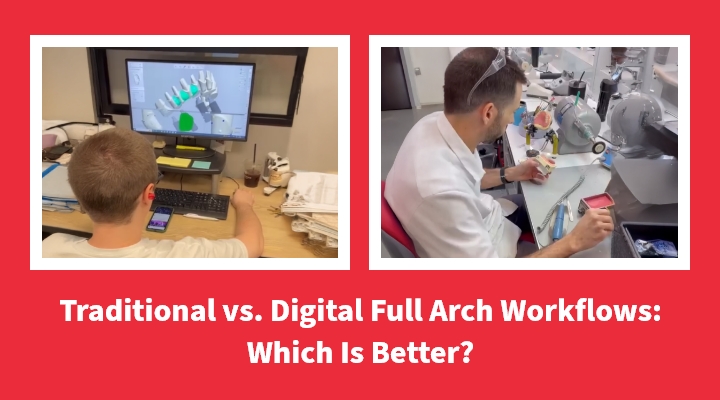
Traditional vs. Digital Full Arch Workflows: Which Is Better?
What Is the Difference Between Traditional and Digital Full Arch Workflows?
Traditional full arch workflows rely on physical impressions, stone models, manual treatment planning, and conventional laboratory processes. Digital full arch workflows use technologies such as intraoral scanning, CBCT imaging, dental grammetry, CAD software, and digital manufacturing to plan and restore implant cases.
While both approaches can produce successful outcomes, digital workflows often provide greater accuracy, improved communication, reduced chair time, and more predictable restorative results.
As implant dentistry continues to evolve, many oral surgeons, restorative dentists, and prosthodontists are adopting digital workflows to improve efficiency and consistency.
Quick Answers About Traditional vs. Digital Full Arch Workflows
What is a traditional full arch workflow?
A traditional workflow uses physical impressions, stone models, analog records, and conventional laboratory fabrication methods.
What is a digital full arch workflow?
A digital workflow uses digital records, virtual treatment planning, CAD software, dental grammetry, and digital manufacturing technologies.
Are digital workflows more accurate?
In many cases, yes. Digital workflows help reduce distortion and improve consistency throughout treatment.
Do digital workflows reduce chair time?
Digital workflows often streamline treatment planning and restorative delivery, reducing appointments and adjustments.
Which workflow is better for full arch implant cases?
Both can be successful, but many clinicians find digital workflows provide greater efficiency, communication, and predictability.
Understanding Traditional Full Arch Workflows
Before digital dentistry became widespread, full arch implant treatment relied almost entirely on conventional techniques.
Typical steps included:
- Physical impressions
- Stone model fabrication
- Analog bite registrations
- Manual treatment planning
- Conventional laboratory communication
- Handcrafted prosthetic fabrication
Many successful full arch restorations have been completed using these techniques.
However, traditional workflows often involve multiple appointments and several opportunities for distortion or information loss throughout treatment.
Advantages of Traditional Workflows
Traditional workflows remain familiar to many clinicians and laboratories.
Benefits include:
- Established clinical protocols
- Familiar techniques
- No major technology investment
- Effective when executed properly
Many experienced clinicians continue to achieve excellent outcomes using traditional methods.
Limitations of Traditional Workflows
Challenges may include:
- Impression distortion
- Physical model inaccuracies
- Additional appointments
- Increased laboratory handling
- More difficult record storage
- Slower communication
These limitations contributed to the development of digital alternatives.
Understanding Digital Full Arch Workflows
Digital workflows use technology to collect records, plan treatment, design restorations, and manufacture prosthetics.
Common technologies include:
- Intraoral scanners
- CBCT imaging
- Dental grammetry
- CAD software
- Digital smile design
- 3D printing
- CAD/CAM manufacturing
By integrating these technologies, clinicians and laboratories can collaborate more effectively throughout treatment.
Comparing Traditional and Digital Full Arch Workflows
Record Collection
Traditional Workflow
Records often include:
- PVS impressions
- Stone models
- Physical bite registrations
Each step introduces opportunities for distortion.
Digital Workflow
Records typically include:
- Intraoral scans
- CBCT imaging
- Digital photographs
- Dental grammetry
Digital records can be reviewed immediately and shared electronically.
Advantage: Digital Workflow
Digital records generally provide greater consistency and efficiency.
Treatment Planning
Traditional Workflow
Planning often relies on physical models and manual analysis.
Digital Workflow
Digital planning incorporates:
- Virtual implant placement
- Prosthetically driven planning
- Digital smile design
- CBCT integration
Advantage: Digital Workflow
Digital planning allows clinicians to visualize outcomes before treatment begins.
Communication With the Laboratory
Traditional Workflow
Communication often occurs through written prescriptions, phone calls, and physical models.
Digital Workflow
Digital files can be shared instantly between clinicians and laboratories.
Benefits include:
- Faster collaboration
- Better case review
- Improved planning
- Reduced misunderstandings
Advantage: Digital Workflow
Digital communication improves efficiency and predictability.
Accuracy and Precision
One of the biggest differences between traditional and digital workflows involves accuracy.
Digital technologies help reduce:
- Impression distortion
- Model inaccuracies
- Information loss
- Human error
Technologies such as dental grammetry further improve precision for full arch restorations.
Advantage: Digital Workflow
Digital workflows often create more accurate restorative outcomes.
Chair Time and Patient Experience
Traditional Workflow
Patients may require:
- Multiple impressions
- Additional appointments
- More verification visits
Digital Workflow
Patients often benefit from:
- Faster appointments
- Greater comfort
- Fewer adjustments
- Improved treatment visualization
Advantage: Digital Workflow
Digital workflows typically improve the patient experience.
Full Arch Predictability
Predictability is critical in implant dentistry.
Digital workflows improve predictability through:
- Comprehensive digital records
- Virtual planning
- Accurate manufacturing
- Better communication
Many clinicians find digital workflows reduce complications and remakes.
Advantage: Digital Workflow
Digital workflows often create more consistent outcomes.
Is Traditional Dentistry Becoming Obsolete?
Not necessarily.
Traditional workflows continue to serve many practices successfully.
However, digital technologies are rapidly becoming the preferred approach for complex implant and full arch cases because of their efficiency and accuracy.
Many practices now utilize a hybrid approach that combines traditional clinical expertise with modern digital technologies.
The Future of Full Arch Implant Dentistry
The trend toward digital dentistry continues to accelerate.
Emerging technologies include:
- Artificial intelligence-assisted planning
- Advanced dental grammetry
- Enhanced digital conversions
- Improved CAD software
- Faster manufacturing systems
These innovations are expected to further improve treatment efficiency and restorative outcomes.
Partner With Wiand Dental Lab
Wiand Dental Lab helps clinicians transition from traditional workflows to advanced digital full arch workflows.
Our team provides expertise in dental grammetry, digital treatment planning, digital conversions, same-day design, and full arch restorative solutions.
Whether you are fully digital or beginning your transition, we can help you improve efficiency, communication, and treatment predictability.
Contact Wiand Dental Lab today to discuss your next full arch implant case.