
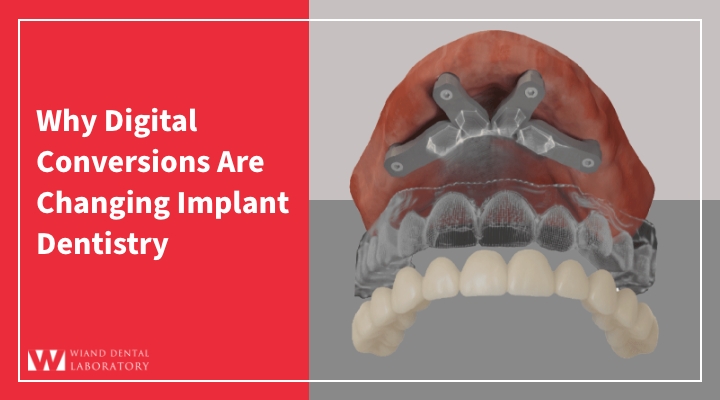
Why Digital Conversions Are Changing Implant Dentistry
Digital conversions are redefining the standard of care in full arch and All-on-X implant dentistry. What was once a purely chairside, acrylic-based process has evolved into a digitally engineered workflow that prioritizes passive fit, load distribution, and long-term prosthetic stability.
In multi-unit implant cases, the conversion phase is not a minor step. It is the structural bridge between surgical placement and restorative stabilization. When that bridge lacks precision, complications follow.
Digital conversions address that risk directly.
The Limitations of Traditional Chairside Conversions
Traditional conversion techniques rely on intraoral pickup of temporary cylinders using autopolymerizing resin. After implant placement, cylinders are attached to multi-unit abutments and captured within a provisional denture.
While effective historically, this method introduces several variables:
- Polymerization shrinkage
- Cylinder displacement during curing
- Inconsistent occlusal contact
- Time pressure during extended surgical procedures
- Limited control over framework reinforcement
In single-unit cases, minor inaccuracies may be manageable. In full arch cases, those inaccuracies multiply. Even slight discrepancies can introduce tension across implants, increasing the risk of screw loosening, prosthetic fracture, or implant overload.
Digital conversions eliminate many of these variables by shifting fabrication from intraoperative improvisation to digital engineering.
What a Digital Conversion Workflow Looks Like
A true digital conversion begins with precise implant-level data capture.
1. Implant Position Recording
Using intraoral scanning or high-accuracy optical systems such as Grammetry or photogrammetry, clinicians capture the three-dimensional spatial orientation of implants. This removes the distortion associated with impression materials and stone models.
The data reflects true implant angulation, depth, and inter-implant relationships.
2. Immediate Digital Transfer
Instead of shipping impressions, implant data is transmitted instantly to the laboratory via secure digital case submission platforms. This eliminates logistical delays and ensures design begins without interruption.
3. CAD-Based Provisional Engineering
In the laboratory, CAD software is used to design the provisional restoration intentionally.
Technicians evaluate:
- Implant angulation
- Restorative space
- Occlusal scheme
- Cantilever length
- Framework thickness
- Reinforcement zones
Rather than adjusting after fabrication, occlusal contacts are engineered digitally. Load vectors can be evaluated before material is milled or printed.
4. Fabrication with Structural Integrity
Provisionals are fabricated using high-strength materials suitable for immediate load. Because the framework geometry was engineered digitally, reinforcement can be built into high-stress areas proactively.
The result is a restoration designed for biomechanics—not just esthetics.
Passive Fit and Biomechanical Stability
Passive fit is one of the most critical determinants of long-term implant success.
In analog workflows, passive fit is often evaluated after fabrication. In digital conversions, passive fit is built into the design stage.
When implant data is captured accurately and frameworks are engineered accordingly:
- Stress across the arch decreases
- Screw loosening risk declines
- Implant micromovement is minimized
- Long-term mechanical complications are reduced
This is especially important in immediate-load cases, where implant stability during osseointegration is essential.
Surgical-Day Efficiency and Reduced Fatigue
Full arch implant surgeries are demanding. Extended chairside acrylic procedures increase fatigue and time pressure.
Digital conversions streamline surgical days by:
- Eliminating prolonged resin curing
- Reducing intraoperative adjustments
- Improving predictability at delivery
- Allowing surgical focus to remain on implant placement
Efficiency improves without sacrificing precision.
Continuity from Provisional to Final Prosthesis
One of the greatest advantages of digital conversions is restorative continuity.
Because the provisional is digitally designed, its validated parameters—vertical dimension, occlusal balance, esthetic alignment—can be transferred into the final zirconia or hybrid restoration design.
This reduces:
- Remakes
- Major occlusal adjustments
- Esthetic redesign
- Framework misalignment
The provisional becomes a blueprint rather than a temporary placeholder.
The Competitive Advantage for Implant Practices
Digital conversions are not just clinical improvements. They are strategic advantages.
Practices that adopt engineered digital workflows benefit from:
- Increased patient confidence
- Reduced complication rates
- Improved workflow efficiency
- Stronger lab collaboration
- Differentiation in competitive implant markets
As implant dentistry continues to evolve, analog conversion methods are increasingly viewed as transitional rather than optimal.
Digital conversions represent the next standard.
Modernize Your Implant Conversion Workflow
If your practice is still relying on traditional acrylic pickup conversions, it may be time to consider a digitally engineered alternative.
Wiand Dental Lab specializes in All-on-X digital conversions and full arch workflows designed for passive fit, structural reinforcement, and long-term implant stability.
Contact Wiand Dental Lab today to elevate your implant restorative process with a precision-driven digital conversion workflow.